
If you have 4C, curly, or coily hair, you already know the struggle. Wash day can feel like a full-time job — fighting dryness, shrinkage, breakage, and frizz all at once. You’ve probably tried every trending product on the shelf, only to end up with hair that still feels thirsty by Wednesday.
Here’s what most people don’t realize: the secret isn’t just what product you use. It’s how you build your routine around it.
That’s where batana oil shampoo changes the game entirely.
In this guide, we’re breaking down a complete, step-by-step batana oil shampoo routine built specifically for 4C, curly, and coily hair types — backed by haircare science, real-user results, and the centuries-old wisdom of the Miskito communities of Honduras, where batana oil was first discovered.
Whether you’re a natural hair veteran or just starting your textured hair journey, this is the routine that can finally give you the moisture, length retention, and definition you’ve been chasing.
What Makes Batana Oil Different for Textured Hair?
Before we dive into the routine, it’s worth understanding why batana oil works so powerfully for curly and coily textures — because it’s not marketing hype. There’s real science here.
Batana oil (extracted from the American oil palm, Elaeis oleifera) is rich in oleic acid (40–50%), which allows it to actually penetrate the hair shaft rather than just sitting on top of the strand. Most oils simply coat the hair. Batana oil goes deeper — nourishing from the inside out.
For 4C and coily hair specifically, this matters enormously. Tightly coiled strands have a naturally harder time moving scalp sebum (natural oils) down the length of the hair. This leaves the mid-lengths and ends perpetually dry and prone to breakage. An oil that can truly penetrate the shaft bridges that gap in a way that lighter oils simply can’t.
Here’s what consistent batana oil use has been shown to do for textured hair:
Length Retention — Reduced breakage leads to visible length milestones. Many 4C naturals report retaining inches of growth they previously couldn’t hold onto because breakage kept pace with growth.
Improved Elasticity — 4C hair becomes more resilient and stretchy, bending rather than snapping when manipulated. This is critical during detangling, styling, and protective style installation.
Balanced Porosity — Over time, batana oil helps normalize porosity issues. High porosity sections get better at retaining moisture, while low porosity areas become more receptive to treatments.
Enhanced Curl Pattern — As overall hair health improves, many users report more defined, hydrated curl patterns emerging naturally — without the need for heavy gels or cast-creating products.
Scalp Health — Chronic dryness, flaking, and irritation often diminish with regular use, creating a healthier foundation for growth.
Understanding Your Hair Type Before You Start
Not all curly hair is the same, and your routine should reflect that. Here’s a quick breakdown of what you’re working with:
4C Hair — The tightest coil pattern with significant shrinkage (up to 75%). Highly prone to dryness and single-strand knots. Needs maximum moisture and gentle handling at every step.
4A/4B Coily Hair — Defined S or Z-shaped coils with moderate-to-high density. Shrinkage is still significant, and moisture retention is a constant concern.
3C Curly Hair — Corkscrew curls with more defined pattern but still susceptible to frizz and dryness, especially at the ends.
Understanding your hair’s porosity is equally important:
- High porosity hair (common in 4C) — cuticles are raised, moisture gets in quickly but escapes just as fast. Needs heavy sealants.
- Low porosity hair — cuticles are tightly closed; needs heat or steam to help products absorb. The LOC method order may need to be adjusted (more on this below).
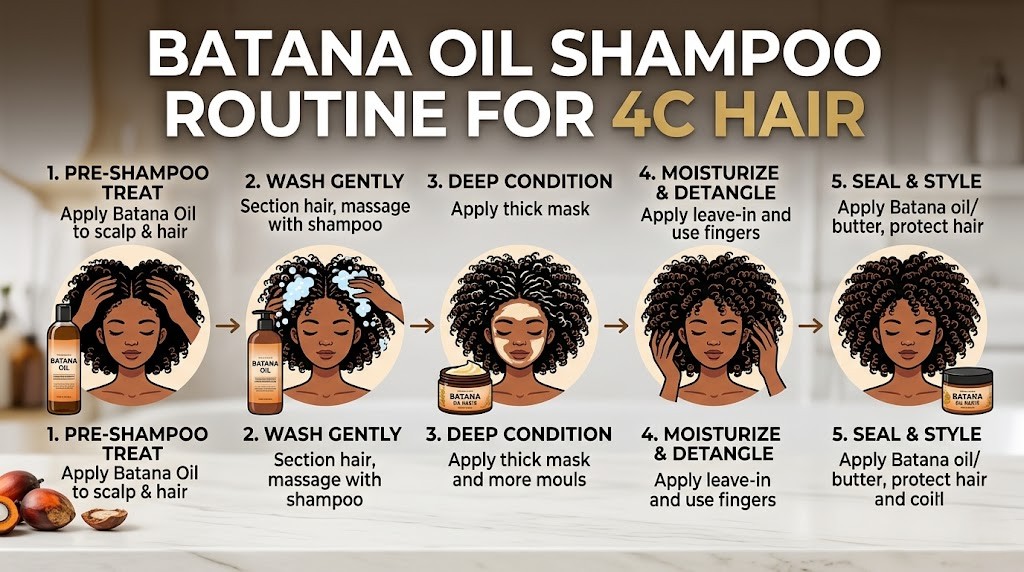
The Complete Batana Oil Shampoo Routine for 4C, Curly & Coily Hair
Step 1: The Pre-Poo (Night Before or 30–60 Minutes Before Washing)
What it is: Pre-pooing (pre-shampooing) means applying oil to dry hair before you shampoo. It creates a protective barrier so the cleansing process doesn’t strip your strands bare.
How to do it with batana oil:
- Start with dry hair that’s been finger-detangled into large sections (4–6 sections works well for most).
- Warm a small amount of batana oil between your palms — it’s thick at room temperature, and warming it makes it more fluid and easier to apply.
- Apply directly to your scalp first, massaging in slow circular motions for 2–3 minutes per section. This stimulates blood flow and encourages absorption.
- Work the oil down the length of each section from roots to ends.
- For coily and 4C hair, focus extra product on the ends — they are the oldest, most fragile part of your hair and need the most protection.
- Twist or braid each section loosely, cover with a plastic cap or satin bonnet, and leave for at least 30 minutes. Overnight is even better.
Pro tip for 4C hair: Add a few drops of batana oil to your go-to deep conditioner for your pre-poo. The combination creates a supercharged treatment that deeply penetrates even the tightest coil pattern.
Step 2: Wash Day — Using Your Batana Oil Shampoo
This is the heart of the routine, and the product you choose here makes all the difference.
A sulfate-free batana oil shampoo is non-negotiable for 4C and coily hair. Sulfates are harsh detergents that strip every last drop of natural moisture from your already-thirsty strands. A sulfate-free formula cleanses effectively without leaving your hair feeling like straw.
How to shampoo correctly for textured hair:
- Wet thoroughly with lukewarm water — not hot. Hot water lifts the cuticle aggressively and strips natural oils. Lukewarm is warm enough to open the cuticle gently for a good cleanse.
- Apply shampoo to the scalp, not the length of your hair. Dispense a quarter-sized amount, emulsify it in your palms, and apply directly to the scalp. The shampoo will rinse through the length naturally.
- Massage in sections. For thick or dense 4C hair, work in 4–6 sections rather than bunching all your hair together. This prevents tangling and ensures the scalp gets properly cleansed.
- Do NOT scrub. Use your fingertips (not nails) to gently massage in a downward motion, following the direction of hair growth. Scrubbing back and forth causes friction and breakage.
- Rinse thoroughly — make sure no shampoo residue remains, as buildup can dull your curl pattern and cause itching.
- For heavily soiled hair or build-up: A double cleanse (shampooing twice) is acceptable, but follow up with an extra-rich conditioner.
Frequency guidance:
- 4C hair: every 1–2 weeks is ideal. Washing too frequently strips oils faster than your scalp can replenish them.
- 3C–4B curly/coily: every 7–10 days, or use a co-wash (conditioner wash) mid-week for refresh without full cleansing.
Step 3: Deep Condition (Non-Negotiable for Coily Hair)
After shampooing, your hair needs intensive moisture replacement before you style. This is not a step to skip.
- Apply a rich, moisturizing deep conditioner generously from roots to ends while hair is still wet.
- If your deep conditioner contains batana oil, even better — it reinforces the moisture work you started in the pre-poo.
- Use a wide-tooth comb or your fingers to detangle while the conditioner is in. Always work from ends upward to minimize breakage.
- Apply gentle heat with a hooded dryer, steamer, or warm towel wrap for 15–30 minutes. Heat opens the cuticle and allows the conditioner to penetrate deeply — especially important for 4C and low porosity hair.
- Rinse with cool water to close the cuticle and lock in the conditioning benefits. Cool water rinses also boost shine noticeably.
Step 4: The LOC or LCO Method — Sealing in Moisture
This is where batana oil earns its place as a starring ingredient in your styling routine. The LOC method (Liquid–Oil–Cream) is a layering technique designed to lock moisture into curly and coily hair for days — not hours.
LOC Method (best for high porosity 4C hair):
- L — Liquid (Leave-In Conditioner): Apply a water-based leave-in conditioner to soaking wet, freshly washed hair. This is your primary source of hydration. The water penetrates the shaft and the conditioner helps it stay there. Spray formulas work well for this step since they penetrate rather than just coat.
- O — Oil (Batana Oil): Apply a small amount of batana oil over the leave-in, section by section. The oil forms a barrier that reduces moisture loss by a significant margin. Because batana oil can actually penetrate the shaft (unlike purely sealing oils), it works double duty here — both nourishing and sealing.
- C — Cream (Styling Cream or Butter): Apply your moisturizing cream or butter last. This is the final seal that locks everything in. For 4C and coily hair, a shea butter-based cream or a thick styling pudding works best.
LCO Method (best for low porosity hair):
If you have low porosity hair (products tend to sit on top rather than absorb), flip the Oil and Cream steps. The cream goes second so it can layer moisture, and the oil goes last to seal everything in. This prevents the oil from creating a barrier that stops the cream from penetrating.
Application tips for the LOC/LCO method:
- Work in small sections — twists or braids — to ensure even product distribution.
- Don’t rush. Each layer needs a moment to absorb before you add the next.
- Less is more. Overloading product causes buildup, not extra moisture.
- After applying all three layers to each section, twist or braid the section to define and protect the curl pattern while it dries.
Step 5: Scalp Care Between Wash Days
Healthy hair starts at the scalp, and 4C/coily hair needs consistent scalp attention — not just on wash day.
2–3 times per week, apply a small amount of batana oil directly to your scalp using a dropper or by dabbing with your fingertip. Massage gently for 5–10 minutes in circular motions to stimulate blood flow and keep the scalp moisturized.
This is especially beneficial if you tend toward scalp dryness, flaking, or slow growth — consistent scalp massage with a nourishing oil like batana has been associated with improvements in all three over time.
Step 6: Protective Styling and Nighttime Care
One of the biggest enemies of 4C and coily hair isn’t your shampoo or your heat tools — it’s your cotton pillowcase. Cotton absorbs moisture from your hair all night, leaving it dry and brittle by morning.
Protect your moisture investment:
- Sleep with a satin or silk bonnet every night. Satin retains significantly more hydration overnight compared to cotton.
- Alternatively, use a satin or silk pillowcase if bonnets feel uncomfortable.
- Refresh your coils between wash days with a light water mist followed by 1–2 drops of batana oil sealed in with your fingers. This prevents dryness from accumulating mid-week.
- Protective styles (twists, braids, buns) reduce daily manipulation and protect your ends — the most vulnerable part of any coily strand.
Weekly & Monthly Routine at a Glance
Weekly:
- Pre-poo the night before or 30+ minutes before wash day
- Sulfate-free batana oil shampoo
- Deep condition with heat
- LOC or LCO method styling
- 2–3x mid-week scalp massages with batana oil
Every 2–4 Weeks:
- Clarifying wash to remove any product buildup (even sulfate-free products can accumulate over time)
- Protein treatment if hair feels mushy, limp, or excessively stretchy — signs of protein deficiency
Monthly:
- Assess your hair’s progress: Is it retaining length? Does it feel more elastic? Is your scalp healthy?
- Adjust product amounts, frequency, or techniques based on what you observe
Common Mistakes to Avoid
Using too much batana oil at once. A little goes a long way, especially for the pre-poo and LOC oil step. Too much creates buildup and weighs down your coils.
Applying products to soaking wet hair. For the LOC method, aim for 80–90% damp — not dripping wet. Excessively wet hair dilutes the products before they can do their job.
Skipping the deep condition. Shampoo cleanses. Deep conditioner restores. You need both.
Detangling dry hair. Always detangle with conditioner in your hair, working from ends upward. Detangling dry 4C or coily hair causes unnecessary breakage.
Washing too frequently. More frequent washing strips the natural moisture that your hair type already struggles to retain. Stick to the frequency guidelines above unless your scalp condition specifically requires more frequent cleansing.
Real Results: What to Expect and When
Patience is part of the process with naturally textured hair. Here’s a realistic timeline for what you can expect:
Weeks 1–2: Hair feels softer and more manageable after wash day. Shampoo leaves no dry, stripped feeling.
Weeks 3–4: Curl pattern appears more defined and hydrated. Frizz reduction becomes noticeable.
Months 2–3: Length retention becomes visible. Fewer single-strand knots and split ends. Scalp dryness and flaking diminish.
Months 4–6: Significant changes in hair thickness, elasticity, and overall health. Curl pattern becomes more uniform. Growth milestones that felt out of reach become achievable.
Consistency is everything. Results compound over time, not overnight.
Frequently Asked Questions
Can I use batana oil shampoo on relaxed or color-treated hair? Yes. Batana oil shampoo is gentle enough for chemically processed hair and actually helps restore moisture and reduce breakage in hair that’s already been through a lot.
How often should I do the pre-poo for 4C hair? Ideally every wash day. For 4C and high-porosity hair, the pre-poo is not optional — it’s the shield that protects your strands from the cleansing process.
My hair is low porosity. Will batana oil still work? Yes, but application technique matters more for low porosity hair. Use the LCO method instead of LOC, apply oil to damp (not dry) hair, and consider a gentle steaming step after your deep conditioner to help products penetrate more effectively.
Can I use batana oil shampoo on my children’s hair? Batana oil shampoo is gentle and formulated for all hair types, including kids. Its sulfate-free and paraben-free formula makes it a safe option for the whole family.
I have 4C hair with mixed porosity (different sections absorb differently). What do I do? This is extremely common. Apply your oil step more generously to high porosity sections (typically the ends and the perimeter) and use slightly less on low porosity areas (often the crown). Over time, batana oil’s balancing effect on porosity will make this less of an issue.
Final Thoughts
Your 4C, curly, or coily hair is not “difficult” — it’s just specific. Once you understand what it needs (moisture, gentle handling, the right layering techniques, and a consistent routine), everything gets easier.
A batana oil shampoo routine addresses every major challenge of textured hair at once: deep cleansing without stripping, real moisture penetration, improved elasticity, and scalp health. It’s not a quick fix — it’s a relationship with your hair built on consistency and the right foundation.
Build this routine. Give it at least 4–6 weeks. And watch what your hair can actually do when it’s properly nourished from scalp to tip.